Simple (and safe) home remedies for cleaning your ears
Using eardrops to soften earwax could help clear a blockage. Learn about 3 safe types of drops you can try at home.

Cleaning wax from your ears is not something you normally need to worry about. In fact, earwax is there for a reason. It keeps the skin in your ear canals moist, traps dirt and slows down bacteria growth.1
But sometimes earwax builds up and hardens in your ear canal, creating a blockage. You might notice that sounds are muffled. Or your ear feels achy or stuffed up.
Think you have an earwax blockage? Your first step should be to have your ears checked by an expert — such as your primary care provider (PCP) or a hearing care professional like an audiologist. They can examine your ears and, if needed, remove excess wax in the office, says Monica Murray, Au.D. She’s vice president of program development at UnitedHealthcare Hearing and the author of our Ask an Audiologist column.
Your provider may also recommend using drops at home to soften and dissolve the wax.2 Here’s what to know about 3 types of drops that are safe to try.
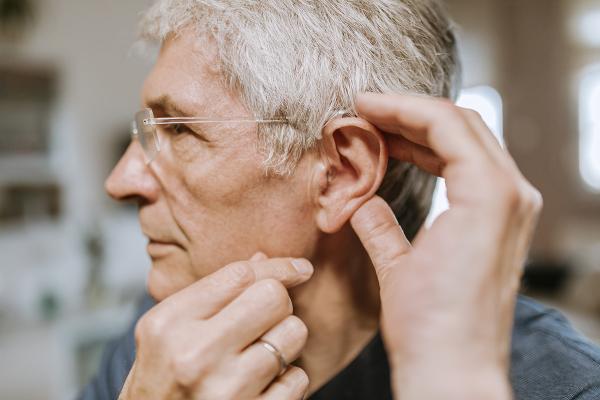
It's estimated that more than 28 million Americans could benefit from hearing aids
Could you be one of them?
Earwax home remedy: Over-the-counter softening drops
What they are: OTC (over-the-counter) softening drops are sold at drugstores and grocery stores. Most contain the same ingredient, carbamide peroxide. Peroxide is good for breaking up wax.3 When it makes contact with your ear canal, it bubbles — which helps soften and loosen wax.
How to use them:
- Tilt your head sideways with the clogged ear facing up. Follow the directions on the package for putting drops in your ear canal.
- Keep your head tilted for a few minutes or lie down with the affected ear facing up. This gives the drops time to work on the wax.
- Use a tissue or washcloth to soak up the liquid and any wax that runs out of your ear.
Earwax home remedy: Hydrogen peroxide
What it is: Hydrogen peroxide is a common antiseptic and cleaner. The 3% household formula comes in a brown plastic bottle and is sold at grocery stores or drugstores. It can be used to help soften and dissolve earwax.4
How to use it:
- Tilt your head with the clogged ear facing upward.
- Use a clean dropper to place a few drops of hydrogen peroxide in your ear canal.
- Keep your head tilted sideways for several minutes so the drops stay in your ear.
- Blot the liquid from your ear with a tissue or washcloth.
Earwax home remedy: Mineral oil
What it is: Mineral oil is a lightweight oil made from petroleum. It has no taste, odor or color and is sold in drugstores and grocery stores. It can be used to soften earwax.
How to use it:
- Tilt your head so the clogged ear faces upward.
- Use a clean dropper to put a few drops of mineral oil into your ear canal.
- Stay still with your head tilted sideways for a few minutes to keep the drops in your ear.
- Use a tissue to blot any excess oil that runs from your ear.
Through EPIC Hearing Healthcare, you get up to 3 follow-up visits at no extra cost and a trial period to try out your new prescription hearing aids. Learn more.
Follow-up move: Flush out your ears in the shower
After you treat your ear with drops, take advantage of your daily shower to give the wax an extra nudge. Stand under the shower stream with your affected ear pointed up so that the warm shower water gently flushes it, suggests Murray. This may further help the loosened earwax work its way out of your ear canal.
Steer clear of these dangerous home remedies
One final note: Never insert cotton swabs into your ear canal to remove earwax.4 Trying to dig it out yourself may push it deeper into your ear canal and even damage your eardrum. Ear candling is also not safe, experts say. There is no scientific proof that this alternative remedy works, and the hot wax from the candle poses a burn risk.
Sources
- Earwax blockage Cleveland Clinic. Accessed February 18, 2026.
- Earwax blockage Mayo Clinic. Accessed February 18, 2026.
- The scoop on earwax Mayo Clinic. Accessed February 18, 2026.
- Earwax removal 101: The best (and safest) ways to clear clogged ears Cleveland Clinic. Accessed February 18, 2026.
Clinically reviewed
Published April 6, 2026
Information is for educational purposes only and is not a substitute for the advice of a licensed medical provider. Consult your provider prior to making changes to your lifestyle or health care routine.
Hearing aids purchased in the Silver technology level will receive 1 follow-up visit.